


What the FY23 Data Says About the Carve-Out Debate
The latest Budget proposed that, from 1 July 2028, companies older than ten years lose the ability to claim RDTI cash refunds, and instead keep only a non-refundable tax offset. For a loss-making company, that is the entire value, and a critical cash injection, gone. The current narrative within the industry discourse is that the Biotech and other life science industries are the most obvious losers from the change. However, historic RDTI claimant data shows there are a number of other industries that may suffer even more severely.
We took the full FY23 claimant list from the ATO transparency report and matched every company to its age at EOFY 2023, industry, and R&D spend. We excluded the top 100 claimants by spend so a handful of giant corporates do not distort the age curve. This data covers the FY23 cohort, not that of 2026, but it is the best proxy available on the shape of the program today.
1. Many industries have longer R&D timelines than Biotech
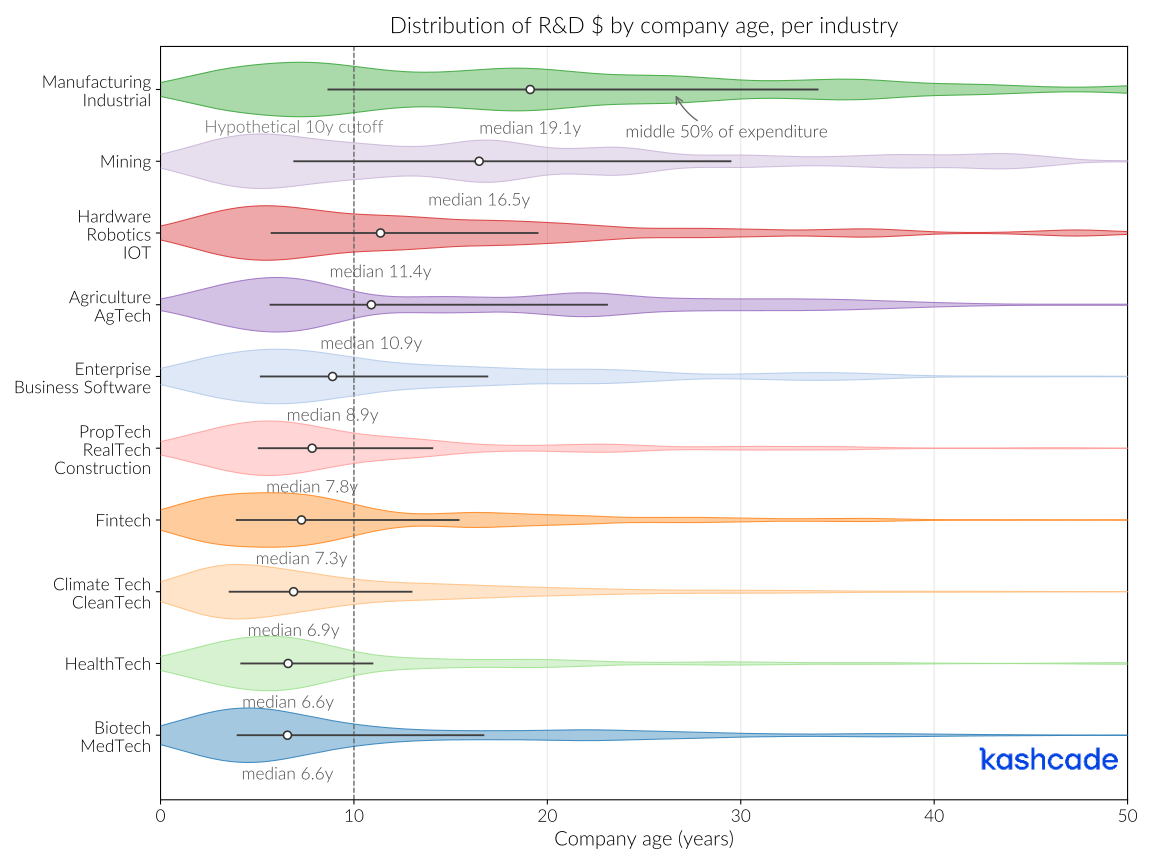
The chart above shows the median age of companies in each industry, weighted by dollars spent on R&D. As such, each dot is the median age of the companies doing an industry’s R&D, weighted by dollars spent; the bar around it captures the middle 50% of that spend. As such, the further right the dot, the older the typical claimant.
The chart shows that biotech’s dot sits at seven years old, one of the youngest in the RDTI program. The bar, however, shows biotech’s spread is one of the widest on the chart, and roughly half of its R&D spend comes from companies ten years or older.
Note: The low median might reflect the sheer volume at the young end – a constant churn of new biotechs spinning out of universities and research institutes, thinning out as companies fail or are acquired around the ten-year mark – not an absence of older claimants.
The case the biotech industry make for being disadvantaged by the new ten-year refund restriction, due to their long R&D timelines, is a strong one. The industry has a large, over-ten-year cohort that the refund restriction would hit hard. However, the point is that biotech is not unusual in this. Several industries have an even older centre of gravity, meaning they too would be severely impaired by such a change.
2. The industries where R&D takes longest build physical things
Looking at which industries sit furthest right on that first chart, a pattern jumps out: they build physical things. Manufacturing (median 19 years), mining (16), hardware and agriculture (both 11) have the oldest centres of gravity in the program. This implies a rough rule that anything built on a physical process runs about five years older than software and services.
The reason for this is structural. Physical R&D moves at the speed of the physical world. Prototyping is done in atoms, not code; these businesses wait on fabrication, materials and tooling; they run field trials across full growing seasons or production cycles; and they work through safety, certification and regulatory approvals measured in years, not sprints. A new version of software can ship and be tested weekly. A new alloy, a mine-site process, an agricultural input or a piece of hardware cannot.
That same physicality makes their R&D expensive, and it is why the cash refund matters most to them. Plant, equipment, materials and trials burn far more cash up-front per project than a software team does, and these companies are the least able to absorb the shortfall if the refund is switched off at year ten. The industries with the longest R&D timelines are also the ones carrying the heaviest R&D cash burden. Removing refundability both clips them later and pulls the most support from the claimants who need it most.
3. Over two-thirds of manufacturing’s R&D happens past year 10
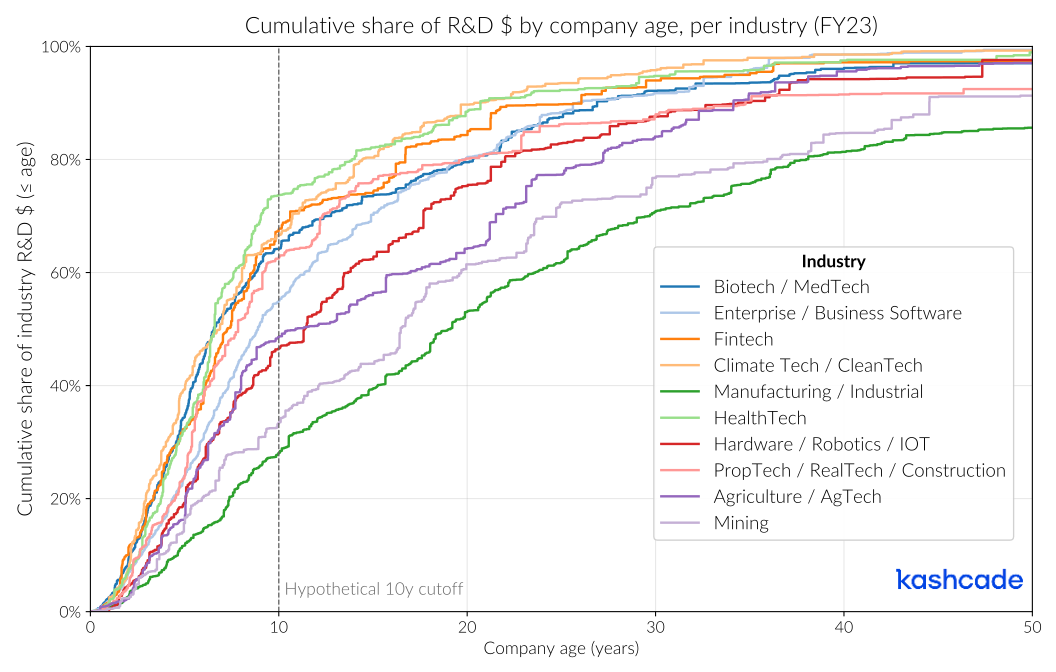
In the chart above, for each industry, the line tracks the running share of that industry’s total R&D dollars accounted for by companies up to a given age. Following a line across the X-axis to the ten-year mark and reading off its height at the Y-axis, that is the share of the industry’s R&D done by companies still inside the ten-year window. Everything above the line, up to 100%, is done by companies older than ten years.
For manufacturing, only about one third of its R&D dollars sit inside the first ten years. More than two-thirds come from companies older than ten. This shows that the refund restriction would clip manufacturing mid-cycle. Mining, agriculture and hardware companies show the same pattern.
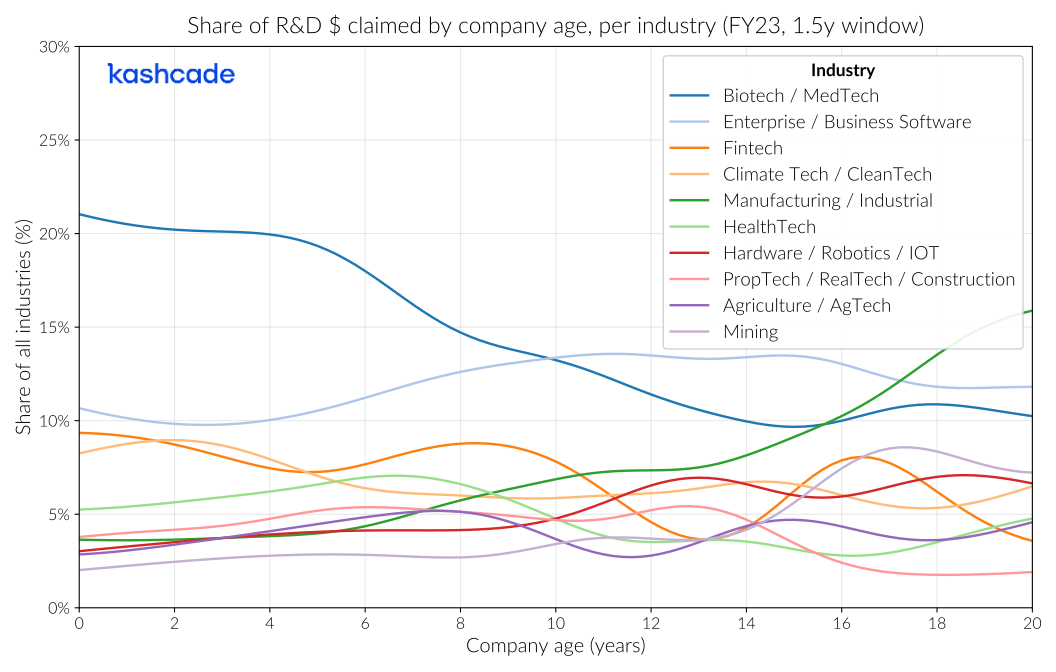
This next chart makes the same point from the other direction. It plots each industry’s share of all RDTI R&D dollars at a given company age. Among the youngest companies, biotech is the single largest slice. But move right along the age axis and manufacturing climbs steadily; by the late teens and into the twenties it overtakes the field. The older the cohort, the more industrial it looks, and the less it looks like life sciences. An exemption built around biotech alone would therefore miss most of the older population a carve-out is meant to protect.
4. Biotech’s long-term R&D case is real, but it isn’t alone
One last cut of the FY23 data explains why biotech’s median came out so low in the first chart, and why that median is misleading on its own.
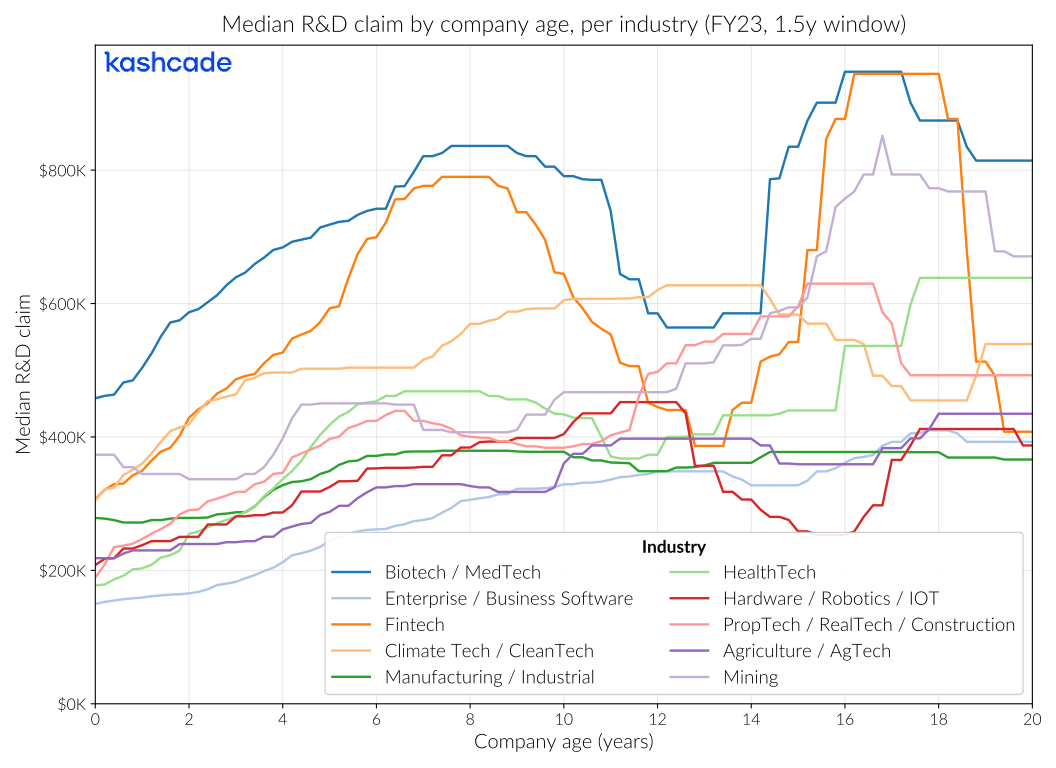
This chart plots the median R&D claim size at each company age. Biotech is clearly bimodal: a large, young population claiming early, then a second, distinct wave of older companies whose claim sizes climb again and peak around the fifteen-to-seventeen-year mark – deep into expensive, late-stage clinical work, well past the ten-year line. The young wave drags biotech’s dollar-weighted median down to seven years (which is exactly why it sits last on the first chart), but the older wave is real, sizeable, and precisely the cohort the refund restriction would penalise.
Once again, biotech is not the only industry with a strong late-stage peak: fintech, climate tech, mining, health tech, and proptech also show their own second peaks further along the age axis (X-axis).
The ‘long-cycle’ signature the life sciences are campaigning on is data, but it is shared across several industries. That is the whole problem with singling out one sector: the pattern it rests on is not unique to that sector, it’s similar in many.
5. Industry categorisation is an inherently flawed approach
It is important to be clear that no industry carve-out has actually been proposed for the RDTI by the government. The ten-year refund restriction, as currently proposed, applies to everyone. The reason an industry-specific version is worth taking seriously is that the Government has already floated exactly that logic in its capital gains tax (CGT) reforms (see: The Innovative Business CGT Concession consultation paper, released on 18 June 2026). Similarly, biotech and other life sciences industry representatives have been rather vocal that a carve-out needs to be applied for them. If that design lands on the CGT side, it is a short step to applying it to RDTI refundability.
From our position, working with hundreds of these companies each year, we’d caution that the premise of an industry carve-out is problematic itself. Primarily, it runs into a definitional wall. What would actually define an “industry” for the exemption? ANZSIC code self-selected at registration? The activities described in the R&D application? A determination by the ATO or the department? Every one of those is gameable, contestable, or simply too blunt to capture what a company really does.
The companies that would suffer most are the ones doing the most innovative work – multi-disciplinary companies that do not fit into a clear industry box. For example, the agricultural technology company building serious hardware or doing real biotech, the manufacturer writing software to complement its hardware. These are often the most innovative claimants in the program, solving the truly novel problems the program is designed to incentivise, yet they’d be at real risk of being miscategorised and penalised.
This is why our read of the data, and the read of much of the RDTI community we have spoken with, is that there should be no ten-year limitation imposed on the program.
In the unfortunate scenario where a carve-out of some sort were to be politically unavoidable, it seems that the better option would be to keep refundability industry-blind and target with cleaner, more categorical levers - things like turnover, profitability, or R&D intensity - that do not ask the ATO to subjectively rule on what business someone is really in.
In a similar scenario, where a year-based restriction remains imposed, it should be drawn at twenty years or longer. A fifteen-year line, like that floated in the CGT consultation paper, would still be inappropriate given the reality of the late-stage R&D occurring in this country.
Bottom line
None of this is law yet, and the ten-year rule remains contestable. The life sciences sector has done the hard work of putting its case on the record, and their case is strong. But a program-wide rule ought to be judged against program-wide data, and the data is clear that the long-R&D problem reaches well beyond life sciences.
Our position is straightforward: the ten-year line shouldn't exist at all. R&D doesn't stop being R&D at year ten, and the data shows the claimants past that mark are disproportionately the capital-intensive, physical-process businesses Australia can least afford to push offshore. If a restriction proves politically unavoidable, keep it industry-blind and lean on objective levers rather than asking the ATO to guess what business someone is really in. And if it must be age-based, draw the line at twenty years, not fifteen.
If the Government wants to wield a scalpel here, it should at least know where the R&D actually occurs. We're engaged with the sector and with government on these changes, and we'll keep publishing what the data shows. If you advise clients in any of the older-skewing industries above, please get in touch before the consultation window closes. The more of this evidence that reaches their ears, the better the final design will be.
Notes on the data: FY23 RDTI claimant population from the ATO transparency report, matched to company age and industry. Top 100 claimants by R&D spend excluded to limit outlier distortion. Industry classifications are Kashcade’s own. Figures describe the FY23 cohort, not a forecast of who will be affected when the changes commence on 1 July 2028.

